Energy · pathway · name
Magma heat distills the brine. Diesel only keeps the plant standing.
Analysis of the FRONTINUS apparatus as a geothermal hydro-distillation column: the average path from ridge discovery to a custom refinery, and the energy the crust already spends versus the energy we have to buy.
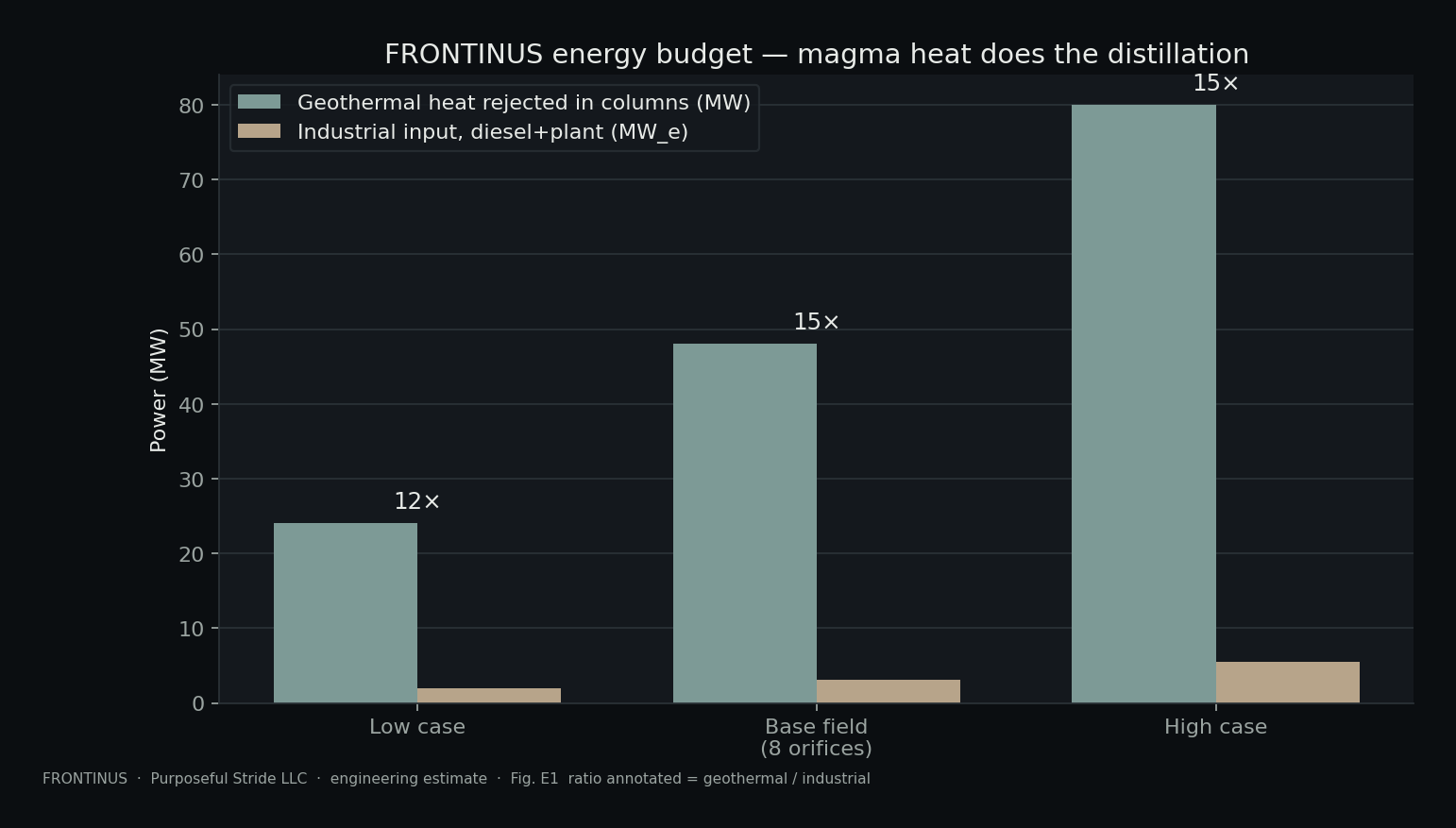
Geothermal (base)
48 MW_th
Industrial input
3.1 MW_e
Ratio
15×
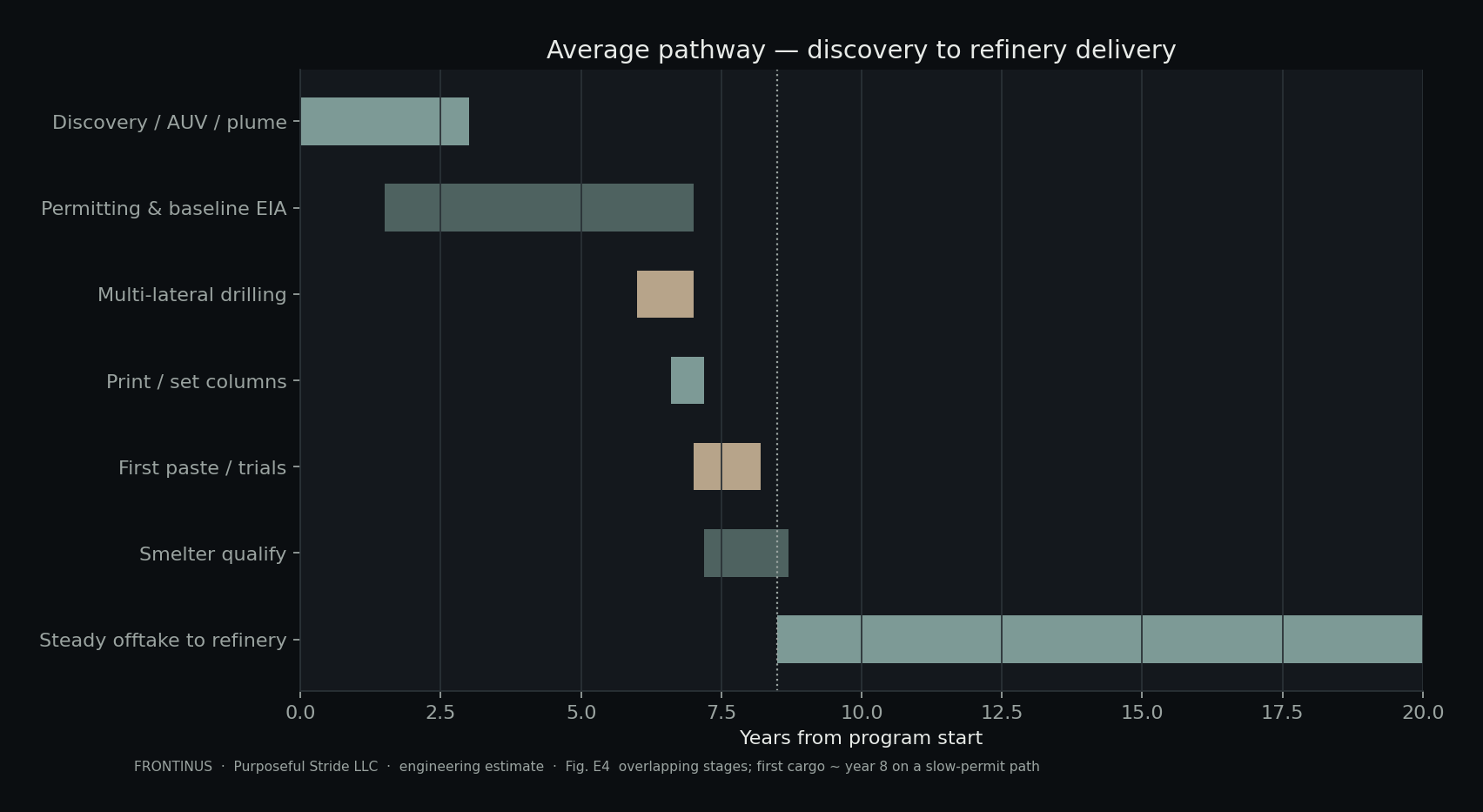
Discovery to delivery
01 · Y0–3
Discovery
Survey ship + AUV, small vs a mine
Plume chemistry, magnetics, and AUV bathymetry pick a MORB reaction zone on the USA–Greenland MAR corridor. No bulk excavation. Energy is ship-days, not mill megawatts.
02 · Y1.5–7
Permit & baseline
Science, not diesel
EIA, vent ecology, and ISA/EEZ process overlap discovery. This is the slow path. Energy cost is low; calendar cost is high.
03 · Y6–7
Drill the laterals
~19 MW_th drillship for ~120 days
Multi-lateral titanium stems into the 350–425 °C zone. This is the largest industrial energy pulse. Ocean hydrostatic recharge then keeps the geyser full.
04 · Y6.6–7.2
Print the columns
U3DCP plant, modest vs drilling
Foamed marine concrete towers, 20–40% closed-cell voids, set over each orifice. Distillation internals (trays at 0.5–0.75 m) go in with the print.
05 · Y7+
Harvest & dewater
~3.1 MW_e against ~48 MW_th geothermal
Brine rises, cools, and drops zoned mud. Only the mud is lifted. The spent fluid returns to the ocean at the column top. Surface centrifuges make 60–80% solids paste.
06 · Y8.5+
Delivery to refinery
Bulk shipping + custom smelter 12–20 GJ/t
Paste totes ride a conventional concentrate route to a custom copper/zinc smelter. FRONTINUS stops at paste. Refining is the offtaker’s existing plant — which is why trial lots should be booked before first cargo.
Energy budget of the apparatus
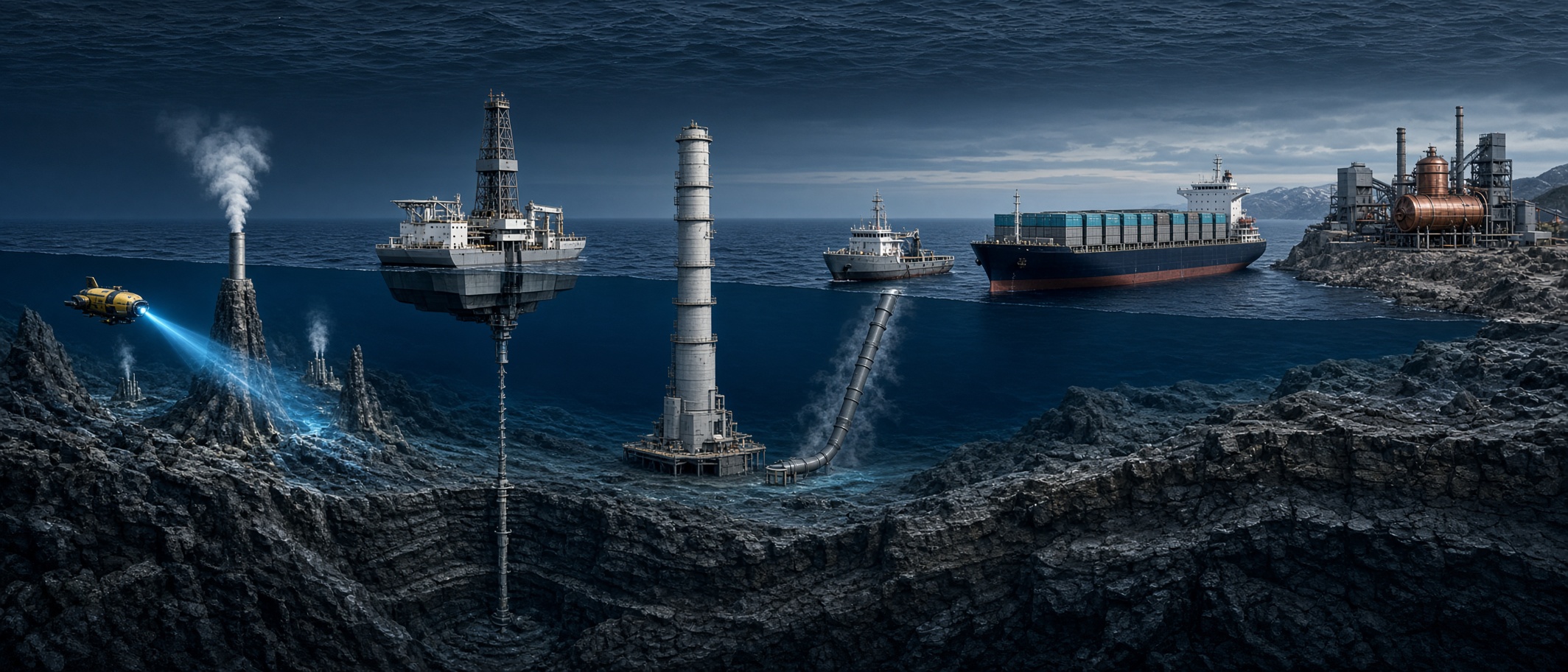
A black smoker already dumps 1–10 MW of 350 °C enthalpy per orifice. FRONTINUS intercepts that stream in a printed column. The cooling cycle is the still. Industrial energy is only the ship, the pumps that lift mud (not the whole brine), and the centrifuge.
- Focused black-smoker heat is typically 1–10 MW per orifice (Ginster mean ~6 MW; Bemis medians ~3–9 MW). Eight engineered orifices at the mean give ~48 MW of 350 °C brine enthalpy rejected through the columns.
- That heat is the distillation energy. FRONTINUS does not fire a boiler. Cooling against seawater drives supersaturation on the collector plates.
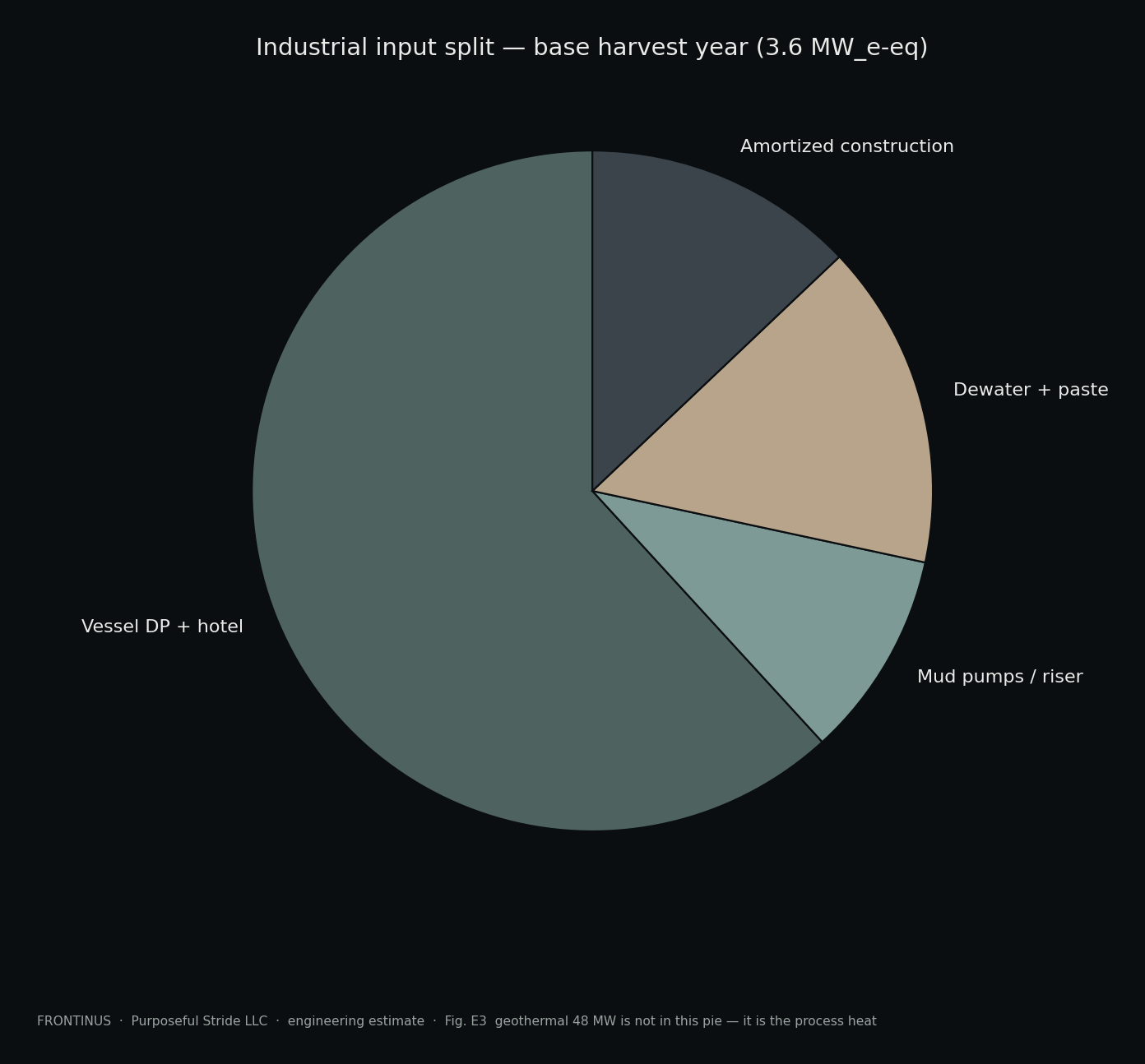
- Industrial input in harvest years is diesel-electric: DP/hotel vessel (~2.2 MW_e), mud/riser pumps (~0.35 MW), dewatering (~0.55 MW), plus ~0.46 MW of construction energy amortized over 20 years.
- Drillship construction is the expensive energy pulse: a DP drillship at ~20–45 m³ diesel/day (~19 MW thermal) for ~120 days, then it leaves.
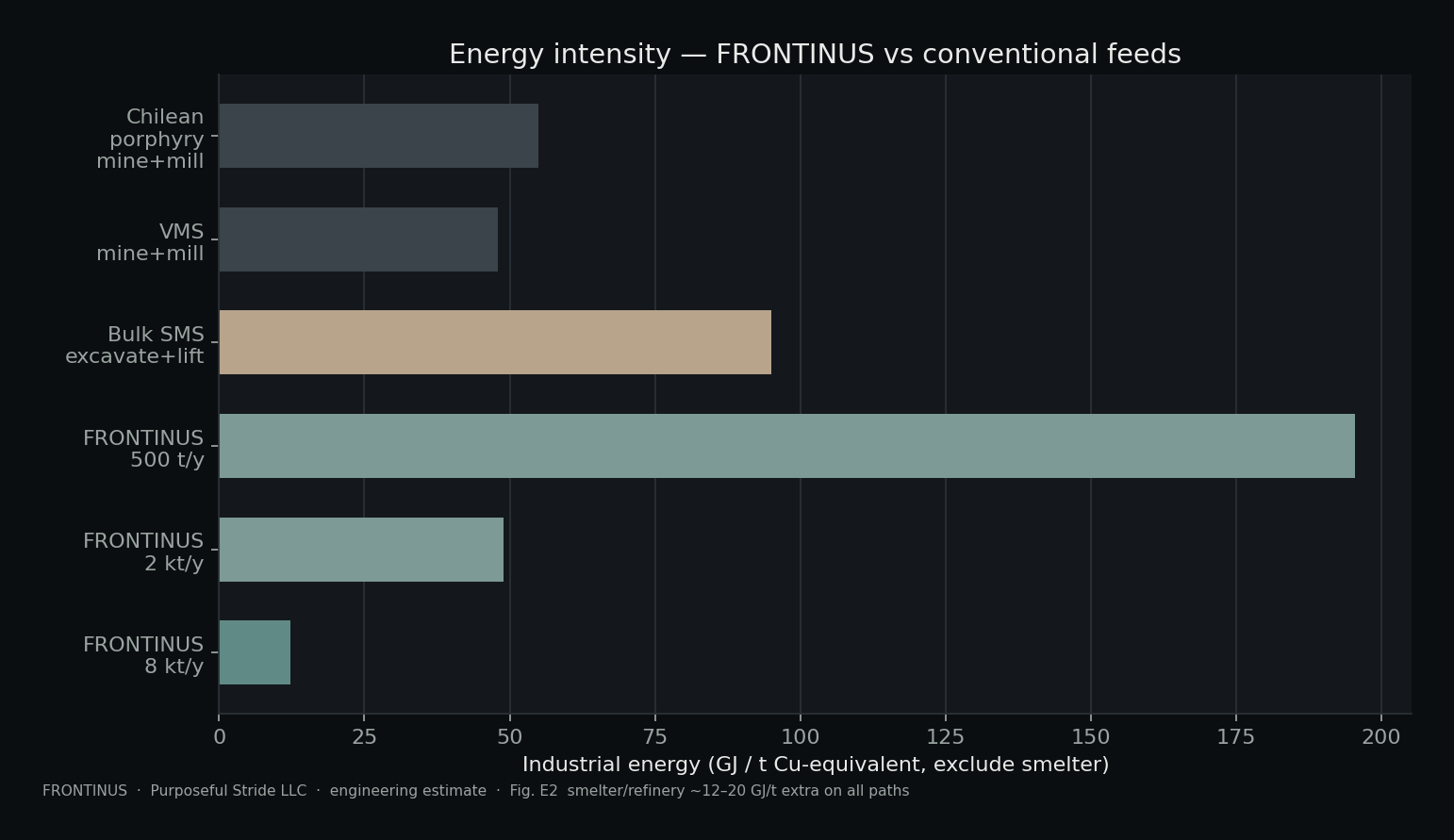
| Path | GJ / t Cu-eq |
|---|---|
| Chilean porphyry mine + mill | 55 |
| Terrestrial VMS mine + mill | 48 |
| Bulk SMS excavate + lift | 95 |
| FRONTINUS at 500 t Cu-eq/y | 195 |
| FRONTINUS at 2 kt Cu-eq/y | 49 |
| FRONTINUS at 8 kt Cu-eq/y | 12 |
FRONTINUS GJ/t uses 3.1 MW_e × 8,760 h. Below ~2 kt/y the ship dominates and the method is not yet energy-cheap. At 8 kt/y it undercuts bulk SMS lift because the column never hoists the rock.
Why the name
Agricola 17.2
subiit sustinuitque molem Iulius Frontinus, vir magnus quantum licebat, validamque et pugnacem Silurum gentem armis subegit, super virtutem hostium locorum quoque difficultates eluctatus.
Julius Frontinus next shouldered the burden. A great man, as far as he was allowed to be, he subdued the powerful and warlike Silures, overcoming both the courage of the enemy and the difficulty of the ground.
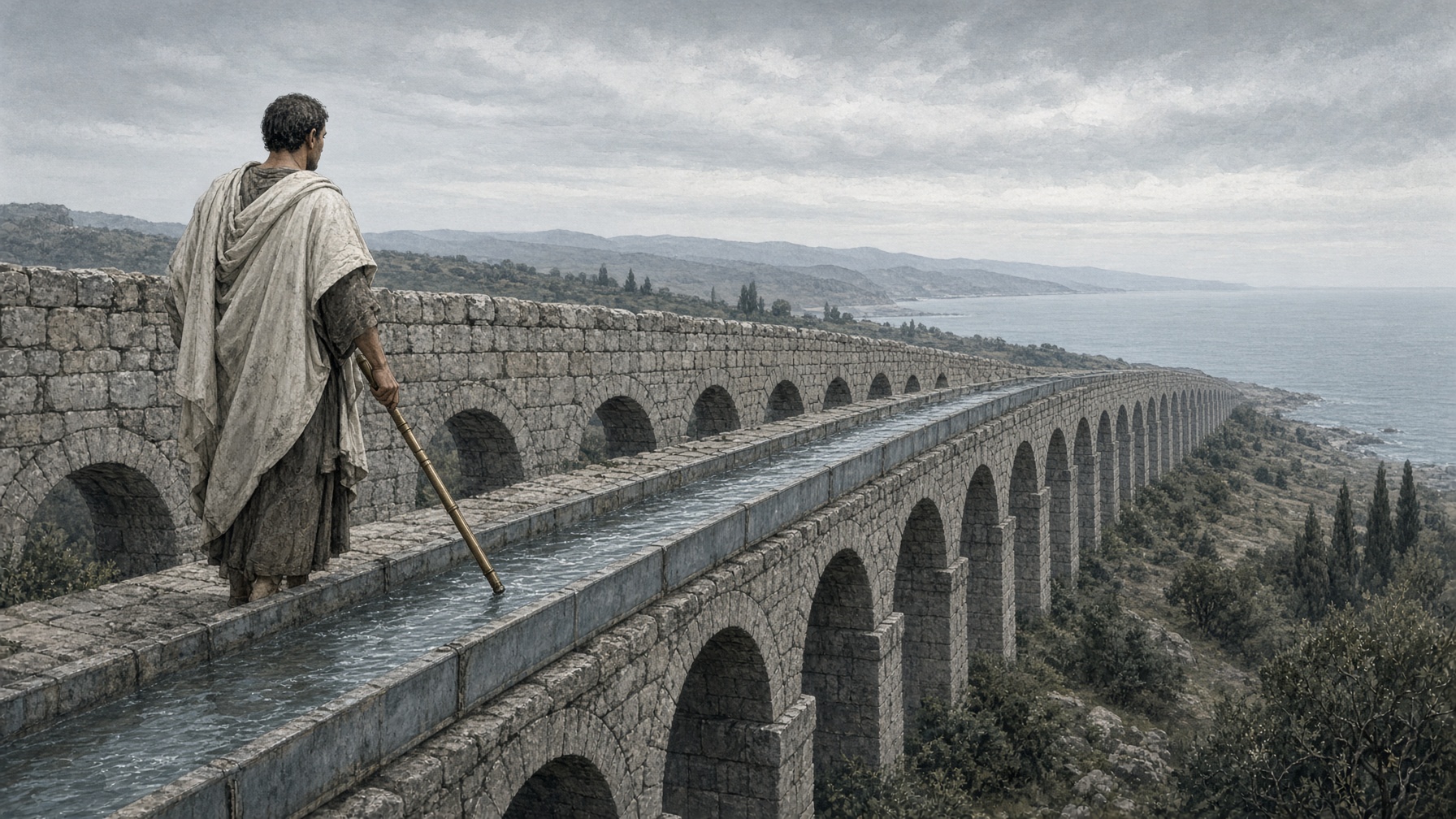
Tacitus records Frontinus as a governor who did real work for Rome under constraint. He later ran Rome’s aqueducts (curator aquarum) and wrote De aquaeductu — a manual of measuring, routing and delivering water through engineered channels. FRONTINUS is named for that habit: take a natural flow, put it in a measured conduit, and deliver a useful product instead of letting it spill.